 Maze Generator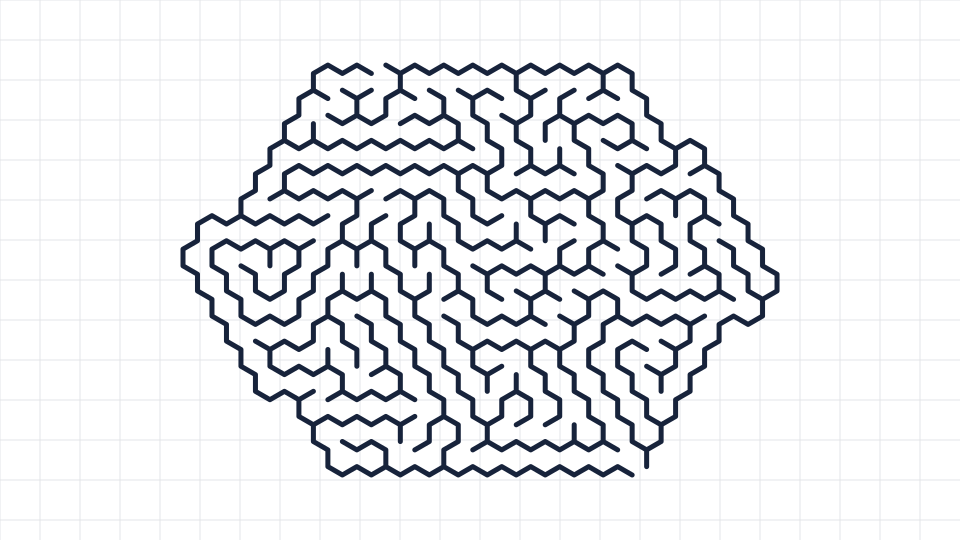
The words come from older maze software: sigma for hexagonal cells, delta for triangular ones, orthogonal for squares. All three tile the plane without gaps, and the generator can use any of them inside any outline.
Hexagonal cells
A hex cell has six neighbours. Rows are staggered so each hexagon nests between two in the row above. The extra neighbours give the algorithms more choices at every step, which produces more branching at the same cell count and makes the correct route harder to guess by eye. A hexagon outline drawn with hex cells is the tidiest combination, with a clean jagged edge all round.
Triangular cells
Triangles alternate pointing up and down. Each has only three neighbours, so corridors are forced into zig-zags: there is no such thing as a straight passage in a delta maze. Visually they are the most striking option, and a triangle outline with triangle cells fits the page like a mountain. They are also the easiest for a printer to spoil, because the acute corners need a crisp line; keep the line thickness at 2 or lower for large ones.
Mixing outlines and cells
The outline is applied as a mask: the generator builds a full grid, drops any cell whose centre falls outside the shape, and keeps the largest connected piece that remains. That means you can put hex cells in a circle, triangle cells in a rectangle, or square cells in a hexagon. Some combinations leave a stepped edge; the circle-of-squares look in particular is popular for children's activity pages.
Size guidance
| Cell style | Easy | Medium | Hard |
|---|---|---|---|
| Square | 10 by 10 | 20 by 20 | 40 by 40 |
| Hex | 8 by 8 | 16 by 16 | 30 by 30 |
| Triangle | 8 by 6 | 14 by 12 | 28 by 24 |
For triangles, width counts pairs of triangles (one up, one down), so a width of 10 draws twenty triangles across.
Which to choose
Use square cells when the maze must be quick to read, such as for young children or a small logo. Use hex cells for a puzzle page that should look modern and take a little longer. Use triangle cells when the maze is decorative as much as playable, on a poster or a party invitation.